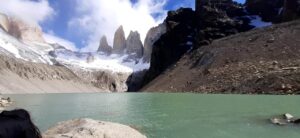
The Dientes de Navarino Trek is one of the most spectacular and wildest routes in Chilean Patagonia. Located on Navarino Island, across from Ushuaia, this 5-day circuit takes you through pristine landscapes of mountains, glacial lakes and sub-Antarctic forests. It is a challenge for true adventurers looking for a unique experience far from everything.
Important: bookings must be made at least 8 weeks in advance, subject to availability of flights or ferry crossings.
Duration: 5 days / 4 nights
Start and end: Puerto Williams, Navarino Island
Season: November to March
Difficulty: High (demanding trek)
Minimum age: 18
Group: up to 6 people
Accommodation in Puerto Williams

The day before the expedition starts we meet for the technical briefing on the days of adventure ahead on the Dientes de Navarino trek. After the meeting we hand out sleeping bags, sleeping mats and trekking poles so you can pack them in your backpack, along with trail rations. The heaviest items, such as the tents, the food and the cooking gear, are carried by our team.
(Distance 11 km – Elevation gain 600 m – Time 6-7 hours)
The adventure begins in Puerto Williams, where the minibus picks passengers up at their accommodation and takes us to the water intake, the trailhead.
The trailhead has a cabin that serves as the Tourist Information Office and CONAF office, with public toilets: the last sign of civilisation you will see in the coming days.
We climb about 3.5 km, up to an altitude of 550 metres. On this first stretch you enter the native sub-Antarctic forest for the first time, and there are even viewpoints and benches to rest. At a good pace you leave the forest and reach Cerro Bandera, with impressive views of the Beagle Channel.
From here you walk practically the rest of the day in high Andean terrain, along the eastern slope of the Róbalo valley, whose hillside will test explorers who suffer from vertigo. Here you can feel the wind coming, and when it does you must keep close to the rock face or the ground. When you have a condor’s-eye view of Laguna del Salto, you go down the first scree slope of the circuit, rocks and loose gravel, to the foot of the lake.
We spend the first night here, as there is clean running water nearby and some flat, dry spots.
(Distance 9 km – Elevation gain 500 m – 5-6 hours)
We set off early along the shore of Laguna del Salto, where we cross the first stream. The second small tributary, which runs down a steep ravine, is the “trail” to follow: a steady climb that soaks your boots from the very start of the day and brings us close to the high peaks of the Dientes de Navarino. The extraordinarily beautiful Paso Primero will not leave you indifferent: at this altitude it is common to find snow even in summer, and the only life you will see is a few cushion plants.
You keep climbing to the pass that marks the end of the Róbalo valley, known as Paso Australia, from where you see Laguna del Paso on the other side. The lake has to be passed along the slope on the right, a dizzyingly steep stretch and one of the trickiest places on the circuit. Outside the summer season this spot is covered by a layer of ice that makes it impassable without special equipment (ice axes, crampons and more). If in summer you find the rocks wet, snowy or icy after rain and a cold night, our advice is to wait and cross it in the afternoon, when the day’s temperature has improved conditions.
Crossing this spot, known as Paso de Los Dientes, takes you to the southern side of Navarino Island. From here, in good weather, you can see the landscape around Lago and Bahía Windhond, and further south even Bahía Nassau or the Cape Horn archipelago.
The rest of the day is plain sailing on flat terrain and a gentle descent, with Laguna del Picacho on your right and, on your left, Picacho de los Dientes, over a thousand metres high (1,118 m a.s.l.). The southern end of the third lake reveals the valley of the trail that forms the Lago Windhond Heritage Route. Here you turn right (heading east) to Laguna de los Dientes, where we recommend setting up the second camp.
Overnight: the Laguna de los Dientes and Cerro Gabriel area has exposed spots next to the lake (in good weather, waking up in front of the lake is a real treat) and others in the forest, a little more sheltered from bad weather.
(Distance 7 km – Elevation gain 300 m – Time 5-6 hours)
The trail keeps following Laguna de los Dientes, always on your left, until Cerro Gabriel is behind you. From there you continue along the valley that opens on the right, with stunted forest and peat bogs. Laguna Escondida is another classic postcard of the Dientes de Navarino: you skirt it keeping it on your right and then follow a stream until you cross it over a beaver dam. Following the valley to the end, past the copses, you come across a boxed-in lake with almost no vegetation. The steep rocky climb ending at Paso Ventarrón offers a picture of contrasts: to the south a green valley dotted with lakes and beaver dams, and to the north (where you have just come from) the hostile peaks of the Dientes de Navarino range.
From this pass you turn west (to the right), skirting a gently rising slope for a few minutes and then a longer, gentle descent. The whole rocky slope is usually very exposed to strong gusts of wind, so take extra care until, lower down, the valley shelters you with shrubs and woodland.
Skirting the last lake, which is also a beaver pond, you reach the foot of Paso Guerrico, a sheltered spot from which you start climbing, first through a forest of twisted trees and then over bedrock largely covered by cushion plants. From Paso Guerrico the valley offers lovely views, with Laguna Hermosa closest to you, which you leave on your right, and the bearings you need to continue the descent over the next hours.
Overnight: the southern end of Laguna Martillo, the part of the lake we reach first, has some flat spots to pitch the tent. Finding dry ground will be hard, but not impossible.
(Distance 10 km – Elevation gain 600 m – Time 6-7 hours)
Before setting off this day, stand facing Laguna Martillo and look at the peaks that guard it. The imposing Cerro Clem with the Lindenmayer mountains form the finest monument to the explorer who opened the route.
The trail continues along Laguna Martillo, always on your left, until a 90-degree turn to the right takes you away from it. Follow the path that brings you back to the other side of Laguna Martillo.
From here on, take great care to follow a trail that barely exists, crossing peat bogs, some beaver dams, Laguna Rocallosa (which you skirt always keeping it on your left), more peat bog and finally a forest that marks the start of the climb to Virginia.
Walk carefully to find the markers of the trail, especially at the entrance to the forest. Once past the first copse and climbing, the trail becomes much easier to see because of the erosion caused by water and walkers. Easy to see does not mean easy to walk: at some times of the year it is a real mud bath and you will need to pull yourself up on the branches of trees and shrubs.
After this stretch the climb is easier, but no less hard. Pay close attention again to find the cairns and follow the trail, especially on the last, exposed high Andean stretch.
The plateau you reach, near the source of a stream, is not to be missed: a few sips of the cleanest water with a spectacular panorama. From this very exposed spot, climbing gently, there are still 500 metres to the highest point of the circuit (848 m a.s.l.). This stretch should be done with good visibility so as not to go off course, as there are snow cornices and rocks on both sides (a compass is highly recommended here – bearing 30 degrees).
The Paso Virginia landmark shows, to the north, the valley of the same name, the Beagle Channel and Tierra del Fuego island. Violent gusts of wind are common here: take maximum care, especially on the first stretch that goes around the cornice, walking to the right. After that you go down the steep slope, sliding down this crazy scree of sand, gravel and rocks, and then skirt Laguna los Guanacos, keeping it on your right.
The viewpoint on the other side of Laguna los Guanacos is not on the trail. Do not cross the river that drains the lake; keep going along the slope on the left, with the river on your right, and then into a beautiful native forest.
Overnight: the forest offers several options to pitch the tent. If the weather is good and it has not rained in the previous days, you will also find good spots to spend the night in front of what remains of Laguna las Guanacas (don’t be scared if you hear a “splash” in the middle of the night: the beaver wants to remind you that you are in its domain).
(Distance 3 km – Elevation gain 300 metres – Time 3 hours)
You skirt Laguna las Guanacas on the right, crossing peat bogs and some patches of forest. In the forest especially, because of the large number of fallen trees, the trail is hard to follow, so pay close attention to the two red lines painted on the trees and some pink ribbons hanging from the branches. When you come out of the tall forest, Puerto Williams appears in the distance.
From here you follow the slope on the right, through copses and calafate bushes, to a large dead trunk standing upright that marks the End of the Trail.
Think you are done? The Dientes de Navarino trail ends in the middle of nowhere, and from here you still walk almost two kilometres along the many paths left by cattle and wild horses. Our advice is not to head straight for the old MacLean fishery but to follow the slope gently downhill towards the Puente de los Bronces, 400 metres east of the fishery. This way you cross pastures, copses and scrub to the Cascada de los Bronces, and from there it is 15 more minutes to the main road.
At the road the tour transfer is waiting to take you back to Puerto Williams, 6 km away, and you will have completed the full 48 km circuit that starts and ends in the southernmost town in the world!